



1. Opening Remarks: Undercurrents Beneath the Deep Freeze
To our loyal AscendEX users, industry colleagues, and believers in the crypto universe:
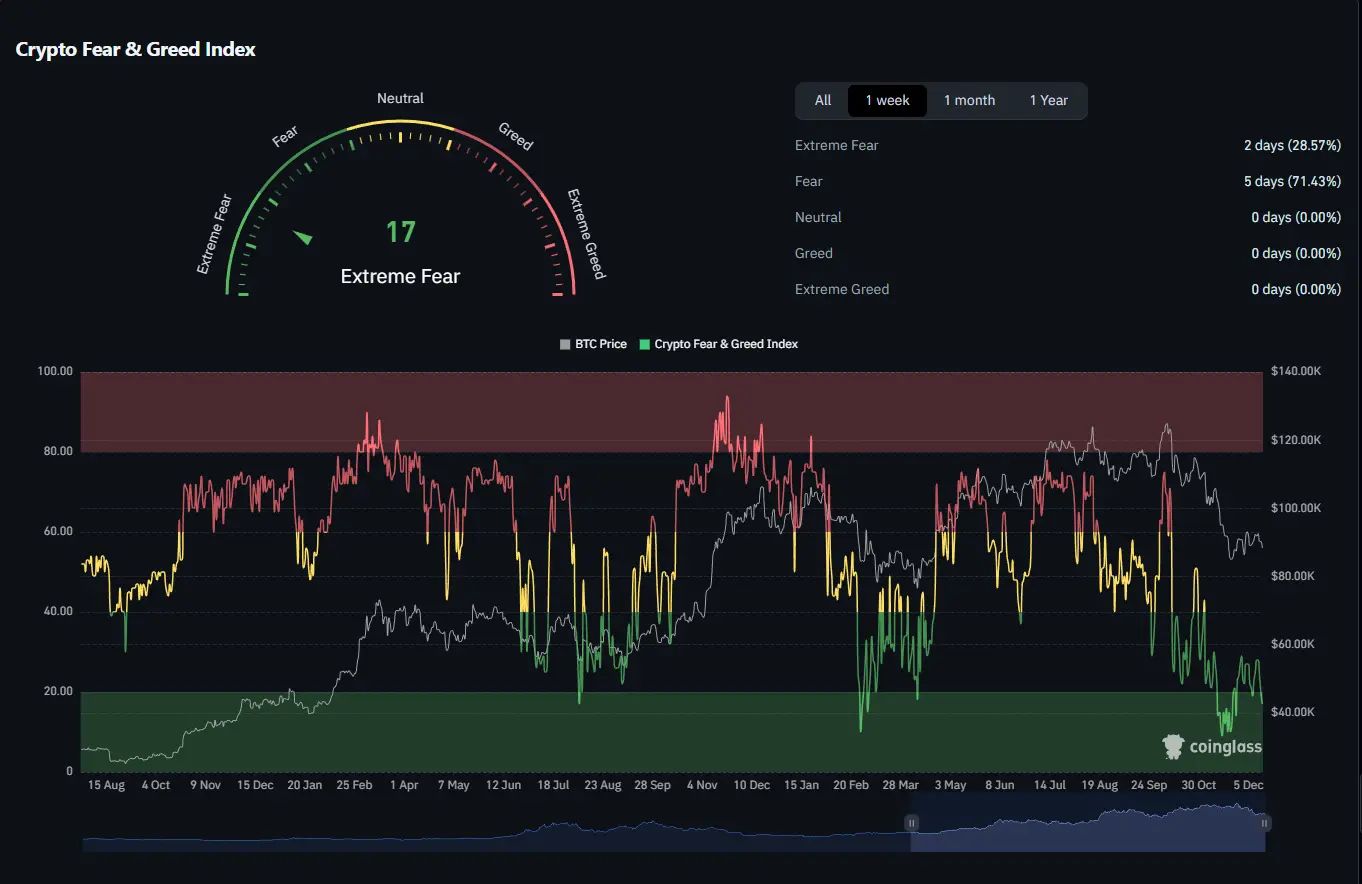
On the surface, this week was defined by an "Extreme Deep Freeze." Bitcoin (BTC), after a failed attempt to breach the $94,000 high, faced resistance and spent most of the week in a lackluster defensive battle around the $90,000 threshold. The Fear & Greed Index plummeted to 21 (Extreme Fear) this week, hitting its coldest point since Q4 began.1 The flashing red numbers on screens, community panic over quantum computers cracking encryption algorithms, and sudden tightening of stablecoin policies from Eastern regulators seemed to weave a suffocating net for investors accustomed to bull market euphoria.
However, as deeply embedded observers of this industry, what we saw at the AscendEX Research terminals was a different picture entirely—violent undercurrents raging beneath the deep sea. This week, the Federal Reserve delivered a 25 basis point rate cut as expected, lowering the federal funds rate to the 3.50%-3.75% range. Yet, Chair Powell’s statement characterizing current operations as "technical liquidity management" mercilessly shattered the market's fantasy of a year-end "flood of liquidity". This was not merely bad news; it was a profound restructuring of macro liquidity expectations: the market is being forced to shift from a "Beta" gain game to an "Alpha" gain struggle.
Even more shocking is the microscopic structural change in the on-chain world. While Short-Term Holders (STH) capitulated and cut losses out of fear, super-whale addresses holding over 10,000 BTC engaged in a scale of chip redistribution rarely seen in recent years—over 36,500 Bitcoin changed hands from weak to strong hands this week.3 This is not a signal of retreat, but of preparation for war.
Meanwhile, the enthusiastic convening of the Solana Breakpoint conference in Abu Dhabi and the scorching primary market raising $176 million in a single week formed a "parallel universe" contrary to the secondary market's price action.4 These conflicting signals interwoven tell us: this is absolutely not the end of the trend, but a critical cycle of narrative rotation and deep chip cleansing.
In this edition, we strip away the noise and use the most solid data and hardcore logic to deconstruct this seemingly calm but actually thrilling week.
2. Market Overview: Divergence and Defense in a Zero-Sum Game
Data Cutoff: Sunday, December 14, 2025, 23:59 (UTC+8)
The global crypto market cap fluctuated narrowly around $3.04 Trillion this week. With a lack of obvious fresh capital inflow signals, the market exhibited distinct characteristics of a "zero-sum game." Bitcoin's dominance further consolidated, while the altcoin market experienced violent differentiation in strength amidst drying liquidity.
2.1 Core Asset Weekly Performance Deep Dive
To reflect the full market picture, we selected 15 assets ranking high in market cap and possessing representative qualities for multi-dimensional quantitative analysis.
(Sources: CoinMarketCap)
Deep Dive Analysis:
The core characteristic of the market this week was "Defense." The relatively controllable drops in BTC and ETH show the resilience of core assets; meanwhile, the counter-trend gains of BNB and TRX were due to the "moats" provided by their exchange ecosystems and stablecoin payment scenarios. In contrast, high-Beta assets like AVAX and SUI suffered heavier sell-offs amidst risk-aversion sentiment.
2.2 Sentiment & Derivatives Data Insight
- Fear & Greed Index: Closed at 21 (Extreme Fear) this week, digging deeper from last week's 29 (Fear).
- Analysis: The index has spent a week in the "Fear" zone, the lowest level since the November correction. Typically, a drop near 20 acts as a contrarian indicator for a local bottom. This extreme pessimism stems largely from investors' irrational reactions to macro policy misses and technical security (quantum threats).
- BTC Dominance: 58.6%.
- Analysis: Driven by risk aversion, capital accelerated its return from altcoins to Bitcoin. The ETH/BTC ratio continues to hover at lows, further postponing expectations for an "Altcoin Season."
- Funding Rates:
- Analysis: BTC perpetual contract funding rates across major exchanges have retreated to neutral (0.01%) or even slightly negative at times. This indicates that long leverage has been significantly washed out, and speculative long interest is at a freezing point. Such a "deleveraged" rate environment often favors price stabilization.
- Liquidation Distribution:
- Analysis: Total liquidations this week exceeded $1.5 Billion, with the most brutal day occurring on December 9, seeing massive volume concentrated on longs.10
- Insight: This cleanse was not a slow bleed but a violent, targeted demolition. Major capital used negative news to precisely strike high-leverage bulls attempting to buy the dip, completing a "violent handover" of chips.
3. Headlines of the Week: 10 Events Reshaping the Landscape
Every major event this week was not just a headline but a turning point profoundly influencing the market landscape of 2025 and beyond.
1. Fed's Final Cut of 2025: 25bps Landed, Why Was the Market "Unimpressed"?
Event Recap: Early morning December 11 (Beijing Time), the Federal Reserve announced a 25 basis point cut to the federal funds rate, bringing it to the 3.50%-3.75% range. This was the third cut of 2025.2
Deep Dive:
The market's cold reaction ("Sell the News") stemmed from a mismatch in expectations. CME FedWatch data showed the market had long priced in this cut (probability was as high as 90%). The real core was Chair Powell's post-meeting speech—he defined current Fed T-bill purchases as "technical liquidity management" and explicitly denied they were "Quantitative Easing (QE)" aimed at economic stimulus.
- Metaphor: The market expected a "flood," but Powell gave "drip irrigation."
- Impact: This temporarily bankrupted the "year-end liquidity flood" narrative that was supporting BTC's charge toward $100k. BTC's rapid retreat to near $90,000 after a brief spike to $94,000 was a direct manifestation of this dashed macro expectation.
2. Regulatory Hammer: Beijing Blocks Tech Giants' HK Stablecoin Plans
Event Recap: This week, authoritative media including the Financial Times confirmed that Chinese regulators (PBoC & CAC) have halted plans by tech giants like Ant Group and JD.com to participate in Hong Kong's stablecoin sandbox and issuance.12
Deep Dive:
This is more than a regulatory action; it is a signal heavily laden with geopolitics.
- Core Logic: Beijing fears that while Hong Kong operates under "One Country, Two Systems," its financial connectivity could make HKD stablecoins a channel for capital to bypass foreign exchange controls and flee disorderly. Furthermore, privately issued stablecoins could pose a potential challenge to the sovereignty of the central bank digital currency (e-CNY).
- Ripple Effect: This decision struck a blow to confidence in the Asian Web3 market. The market had widely expected Hong Kong to become a global hub for RWA and stablecoin payments; now, this vision faces huge uncertainty, causing some capital betting on the Asian compliance narrative to withdraw.
3. Google "Willow" Quantum Chip Sparks Irrational Panic
Event Recap: Google announced its latest quantum computing chip, "Willow," achieved breakthrough progress in specific computational tasks, completing in minutes what traditional supercomputers would take ten thousand years to do.10
Deep Dive:
This news triggered FUD (Fear, Uncertainty, Doubt) on social media about "Bitcoin's encryption algorithms being cracked." But technically, this is completely irrational.
- Technical Debunking: Google's breakthrough lies in "quantum supremacy for specific tasks." It is still decades or further away from having the millions of error-correcting qubits needed to run Shor's algorithm to crack SHA-256 (Bitcoin mining algorithm) or ECDSA (Elliptic Curve Digital Signature Algorithm).
- Market Psychology: This panic reflects the fragility of current market sentiment—any disturbance can become a reason to sell.
4. Bhutan Government Moves Bitcoin: Sovereign Supply Pressure Returns
Event Recap: On-chain data sleuths discovered that wallet addresses associated with the Government of Bhutan transferred a large amount of Bitcoin to centralized exchanges this week.10
Deep Dive:
Bhutan is one of the few sovereign nations using state-owned hydropower for large-scale Bitcoin mining. Their holding cost is extremely low, and moving chips at this time is likely to cash out to fund domestic infrastructure or meet fiscal needs.
- Comparison: Similar to the clearance-style selling by the German government previously, sovereign-level selling pressure brings not only a substantial supply shock but also oppression to the market's psychological defense line.
5. Solana Breakpoint Conference & "SKR" Airdrop Hype
Event Recap: The Solana ecosystem's annual gala, Breakpoint 2025, was grandly held in Abu Dhabi from Dec 11-13. At the event, Solana Mobile announced the launch of the "SKR" token, with a total supply of 10 billion, 30% of which will be airdropped to mobile device users.5
Deep Dive:
Against a weak broader market, Solana demonstrated strong independent narrative capability.
- Ecosystem Loop: By combining Hardware (Saga Phone) + Token (SKR) + Apps (dApps), it constructed a complete DePIN flywheel. The SKR airdrop expectation not only locked in existing SOL liquidity but also attracted a large number of new users to the ecosystem, explaining why SOL's on-chain data remained stellar this week.
6. Whale Awakening: Satoshi-Era Wallets Move
Event Recap: Multiple "Satoshi-era" wallets dormant for over 14 years suddenly woke up this week, transferring tens of thousands of BTC.14
Deep Dive:
Movements by such "Old Whales" are often viewed as "deep signals" of the market.
- Signal Interpretation: This is not simple dumping, but profit-taking and asset allocation rebalancing by long-term holders. Glassnode data shows that while short-term holders are losing money, long-term holders are distributing chips to the market, a typical characteristic of the mid-to-late bull market or consolidation phases.
7. MicroStrategy Volatility & Leverage Flush
Event Recap: As the largest corporate holder of Bitcoin, MicroStrategy (MSTR) shares fluctuated violently with BTC prices this week, even seeing larger drops than BTC itself.15
Deep Dive:
MSTR has essentially become a "leveraged token" for BTC. Its stock price decline conversely affected crypto market confidence, forming a "negative feedback loop." The market began to worry that if BTC falls below specific support levels, whether MSTR's aggressive debt financing model is sustainable, exacerbating risk-aversion sentiment.
8. US Advances CLARITY Act Legislation
Event Recap: The US Senate was scheduled to vote around Dec 8 on the CLARITY Act, aimed at providing a clearer regulatory framework for crypto enterprises.16
Deep Dive:
Although the legislative process is long and variable, increased regulatory clarity is a prerequisite for large-scale institutional capital entry. This is the fundamental reason why VC financing in the primary market remains active despite price drops—institutional investors are betting on the trillion-dollar market after compliance is achieved in 2026.
9. XRP ETF Inflows Defy Trend
Event Recap: Despite XRP price drops this week, XRP-related ETP/ETF products recorded net inflows.17
Deep Dive:
This is typical institutional "left-side" positioning behavior. After winning partial legal victories against the SEC, XRP is viewed as the third largest "quasi-compliant" asset after BTC and ETH. Institutional investors are using the correction to accumulate chips, betting on the future official approval of XRP ETFs in the US.
10. Fundraising Defies Gravity: $176M Raised
Event Recap: The crypto primary market raised a total of $176 million this week, unaffected by the secondary market freeze.4
Deep Dive:
Infrastructure and RWA projects like LI.FI ($29M) and Real Finance ($25M) received massive funding. This shows that Smart Money does not care about short-term K-line fluctuations but is firmly betting on the Infrastructure layer and the Real World Assets (RWA) track.
4. Deep Dive: DefiLlama TVL Insights
Core Insight: Amid extreme market fear, capital is fleeing high-risk Meme sectors and speculative public chains, flocking instead to DeFi protocols offering "Real Yield" and "Safe Haven" properties.
4.1 Global TVL Overview
As of Sunday, total DeFi TVL maintained around $133.88 Billion. Although up ~150% YTD, recent growth has stalled. The stability of this figure against the backdrop of falling coin prices is particularly valuable, indicating that coin-denominated assets did not flee en masse but remained in protocols to earn interest.18
4.2 Top Performing Sectors Deep Analysis
- Liquid Restaking (LRT) - The Bear Market Sanctuary
- Leaders: Ether.Fi, EigenLayer, Renzo.
- Data: EigenLayer TVL stable above $17 Billion; Ether.Fi TVL broke $9 Billion.
- Deep Logic: Why is LRT still hot when ETH prices are weak ($3,100)? Because for long-term ETH holders, selling is unacceptable, while traditional Staking yields (~3%) lack appeal. LRT protocols allow users to earn ETH staking rewards plus additional yields and point expectations from AVS (Actively Validated Services) via restaking. This "eat one fish multiple ways" model successfully locked up massive ETH selling pressure that would have otherwise flooded the market.
- RWA (Real World Assets) - The Magnet for On-Chain Risk-Free Rates
- Leaders: Ondo Finance, MakerDAO (Sky).
- Trend: Despite Fed cuts, on-chain Tokenized Treasuries remain highly attractive.
- Deep Logic: Current US Treasury yields remain in the 3.5%-4% range, while stablecoin lending rates in DeFi often fluctuate violently. Institutional funds are converting idle USDT/USDC into on-chain Treasuries via RWA protocols to gain stable, compliant USD-denominated yields. This marks DeFi's transition from "Ponzi Yields" to "Real World Yields."
- Solana DeFi Ecosystem - The New Engine for Mobile Narrative
- Data: Solana TVL bucked the trend, rising slightly to near $8.98 Billion. Stablecoin market cap grew 3% to $15.58 Billion.19
- Drivers: Besides the inertia of MEME trading, liquidity protocols on Solana (like Kamino, Marginfi) are attracting users to lock assets via "Points" campaigns. More critically, the SKR token announced at Breakpoint directly stimulated mobile DeFi activity. Solana is bridging the last mile for Web2 users to enter Web3 DeFi through the "Phone + Crypto" combo.
5. On-Chain Highlights: The Whale's "Handover" Game & Retail Defeat
This week's Glassnode on-chain data reveals a brutal truth: the market is undergoing a massive exchange of chips—from shaky short-term traders to deep-pocketed long-term whales.
- Whale Activity:
- Data: Whale entities holding 10k-100k BTC transferred or reallocated approximately 36,500 BTC (worth ~$3.37 Billion) this week.3
- Interpretation: Movements of this magnitude rarely occur in a dead bear market but rather at critical junctures of trend reversal. Whales are using market panic to adjust positions. While some old whales are selling, new institutional-grade whales are accumulating in this price range ($88k-$90k).
- Realized Profit/Loss:
- Data: The Short-Term Holder (STH) MVRV ratio has dropped below 1.0.20
- Interpretation: This means retail investors who entered in the past few months are now in a comprehensive floating loss state. On-chain data shows STH are cutting flesh (Realized Loss dominance), and panic chips are being cleansed. In contrast, while Long-Term Holders (LTH) are selling, it is more to lock in annual profits than panic selling.
- Exchange Balance:
- Trend: Despite falling prices, BTC balances on mainstream exchanges did not pile up significantly.
- Interpretation: This indicates that this week's selling pressure was digested mainly through derivative market liquidations, rather than massive spot dumping. Spot holders' confidence remains stronger than that of contract traders.
6. Financing & Project Updates: Infrastructure & Compliance Lead
Even in the secondary market winter, the primary market remains hot. Total financing this week was $1.76 Billion, with capital flows very clear: no longer chasing ethereal concepts, but solid Infrastructure and Compliance tracks.4
- LI.FI ($29M):
- Investors: Led by Multicoin and CoinFund.
- Significance: As a cross-chain liquidity aggregator, LI.FI's large financing shows that "multi-chain interoperability" remains a rigid need. With the explosion of L2s and heterogeneous chains, seamless capital flow between chains is the key proposition for 2026.
- Real Finance ($25M):
- Sector: RWA Infrastructure.
- Significance: Focused on providing underlying technical support for bringing real-world assets on-chain. Institutions are betting on the long-term trend of asset tokenization, contrasting sharply with the regulatory blockage in Hong Kong this week—technology marches on, despite policy twists.
- TenX ($22M):
- Sector: Institutional-grade staking and validation services.
- Significance: This is typical infrastructure paving the way for Wall Street capital. Traditional institutions need compliant, secure Staking channels, and TenX fills this gap.
- Solana Mobile "SKR":
- News: The launch of the SKR token is a milestone event combining Web3 hardware with tokenomics.
- Outlook: This foreshadows that "DePIN + Mobile" will be a core narrative for 2026. Phones are not just communication tools but mobile mining rigs and validation nodes.
7. Regulation & Macro: West vs. East "Temperature Difference"
This week, the macro and regulatory levels presented a clear "Warm West, Cold East" pattern, a geopolitical misalignment that will profoundly affect future capital flows.
- West (USA/UAE): Easing & Embracing
- Fed: Continued rate cuts; although steady, the general direction remains an easing cycle. The liquidity turning point has passed; the future is just a question of flow volume.
- Legislation: The CLARITY Act advances as the US attempts to build a comprehensive crypto regulatory framework by 2026, which will remove the biggest legal barrier for institutional entry.
- Middle East: Binance obtained the UAE ADGM license, marking the Middle East as a continued global haven and hub for cryptocurrency. The UAE is siphoning global Web3 resources with extremely friendly policies.22
- East (China/HK): Prudence & Red Lines
- Hong Kong: China's halt on tech giants' HK stablecoin plans shows that on issues involving monetary sovereignty and capital controls, Beijing's red line remains untouchable.
- Impact: This is a substantial blow to Hong Kong's ambition to become a Web3 hub. The channel originally expected to connect mainland and global funds via stablecoins has been cut, which will limit Asian capital entry speeds in the short term, leading some projects to reassess their HK layouts.
8. A Picture is Worth a Thousand Words
(Note: Descriptions and data sources below, please view live data via CoinGlass links)
- Fear & Greed Index Trend (Nov-Dec):
- Description: A steep line diving from "Greed" last month straight to "Extreme Fear (21)" this week. Such a V-shaped reversal is often a leading indicator of a sentiment bottom and impending rebound.
9. Outlook: Next Week (December 15 - December 21)
Keywords: The Unlock Test, Year-End Liquidity Drain
Entering mid-December, as the Western Christmas holiday approaches, market liquidity will dry up further, potentially amplifying volatility unexpectedly.
- Massive Token Unlocks Warning: Next week brings a terrifying "Unlock Week," testing the market with hundreds of millions in selling pressure.
- Arbitrum (ARB): Unlock worth ~$50.25M on Dec 16. As an L2 leader, this unlock could significantly suppress price.
- Starknet (STRK): Unlock worth ~$17.45M on Dec 15.
- LayerZero (ZRO): Unlock worth ~$49.5M on Dec 20.
- Strategy: Unlocks of this magnitude typically cause a short-term Supply Shock. It is advised to avoid spot long positions in related assets around unlock dates or hedge accordingly.
- Macro Data Void:
- No major Fed meetings next week (FOMC is past). The market will be driven more by on-chain capital games and sudden news. This gives the crypto market a window for self-repair and finding independent trends.
- Price Range Forecast:
- BTC: Key support is at $88,000. If held, a counterattack to test $92,000 before year-end is possible; if lost, the next strong support is in the $82,000 - $84,000 range, which would be an excellent buy zone for the mid-to-long term.
10. Conclusion & CTA
Finding Light in Extreme Fear
This week's market performance was undoubtedly dull and depressing. Whether it was the slow bleed of prices, the cold water of regulation, or quantum panic, it seems to be testing the nerves of every Hodler. But as the Head of AscendEX Research Institute, I want to remind everyone: The history of the crypto market has proven countless times that the best buying opportunities always appear when no one is interested or during extreme panic.
While short-term speculators flee because a 25 basis point cut didn't bring a moonshot, true long-term builders are constructing the future financial edifice through RWA, LRT, and DePIN tracks. Do not let fear blind your eyes; keep a close watch on those projects that are still financing, developing, and delivering code in the dead of winter.
AscendEX is always with you, traversing through bulls and bears.
(Disclaimer: This report is for reference only and does not constitute any investment advice. Crypto assets are highly volatile; please ensure risk control, DYOR - Do Your Own Research.)